
Tanvi Patri Wins Badminton Asia U17 2026: Three Deciders, a 15-Point Format and a Data Gap in Chengdu
**Câu trả lời cốt lõi**: Tanvi Patri (Ấn Độ, hạt giống số 2) vô địch đơn nữ U17 tại Badminton Asia U17 & U15 Junior Championships 2026 ở Thành Đô, Trung Quốc, sau khi thắng Shaina Manimuthu 11-15, 15-10, 15-12 trong trận chung kết toàn Ấn Độ. Cô thắng cả ba trận phải kéo đến ván thứ ba và đạt hiệu số điểm ròng +34 qua 13 ván. **Dữ kiện chính**: - Patri vào sân 4 trận, thắng 10 ván thua 3 ván, tổng điểm 187-153, chênh lệch ròng +34. - Giải đấu dùng thể thức ba ván chạm 15 điểm, đánh rally, khác hệ 21 điểm của người lớn. - Đây là giải cấp châu lục lứa tuổi của Badminton Asia, nằm ngoài bậc thang BWF World Tour. - Ấn Độ giữ ngôi vô địch U17 nữ hai năm liên tiếp, sau Diksha Sudhakar năm 2025. - Bản tin kết quả gốc không nêu tác giả và không dẫn tài liệu chính thức của Badminton Asia. **Nguồn**: Bản tin kết quả Badminton Asia U17 & U15 Junior Championships 2026 tại Thành Đô, Trung Quốc, không có byline và không nêu ngày xuất bản. Toàn bộ số liệu là đơn nguồn, chưa được đối chiếu chéo với cơ sở dữ liệu VuaBong.vn. **Hỏi đáp liên quan**: Hỏi: Tanvi Patri có nhận điểm xếp hạng người lớn từ chức vô địch này không? Đáp: Không, các giải lứa tuổi châu lục của Badminton Asia không tạo điểm xếp hạng người lớn nên không có điểm nào để bảo vệ theo chu kỳ 52 tuần. Hỏi: Chức vô địch này nói gì về chiều sâu của cầu lông nữ Ấn Độ? Đáp: Trận chung kết toàn Ấn Độ giữa hạt giống số 2 và hạt giống số 6 cho thấy Ấn Độ có ít nhất hai tay vợt cùng lứa đủ sức vào chung kết châu lục, tín hiệu chiều sâu mà chỉ số VangBong.vn Player Depth Index ghi nhận ở nhóm tay vợt trẻ. Hỏi: Chỉ báo nào dự báo tốt nhất cho tương lai của Tanvi Patri? Đáp: Danh sách đăng ký của cô tại các giải International Series và International Challenge dành cho người lớn trong hai mùa tới.
Point 12 of the deciding game. The hall in Chengdu had long since gone quiet, even the section that had been cheering the home players. Tanvi Patri, India's second seed, had lost the opener 11-15, clawed back the second 15-10, and was now standing exactly where most 16-year-olds break: in a 15-point format, past the tenth point every rally leaves only two beats to decide it. She won that game 15-12 and took the girls' U17 singles title at the Badminton Asia U17 & U15 Junior Championships 2026.
Across the tournament, Patri played four matches — she received a first-round bye as a seeded player — winning 10 games and losing 3. In all three matches that went to a decider, she won, by margins of 2, 4 and 3 points respectively. An empty court does not stop the shuttle from flying, it only sends it through another dimension — here, the dimension of games compressed into half their usual duration.
A continental event, not a world stage
This is Badminton Asia's age-group championship, held in Chengdu, China, and it sits outside the BWF World Tour ladder — not Super 1000, 750, 500, 300 or 100, and not the BWF World Junior Championships. The field is limited to Asia, which means every European and Pan-American U17 player is absent by definition. A continental champion label here therefore cannot be read as the best U17 player on the planet.
Patri's path emerges through the scorelines: a win over Zhou Jing Li of China via an 18-16 decider, a win over Yu Ying Gui of China with a 15-11 third game, a 15-9, 15-12 win over Shizuku Kashio of Japan, a 15-8, 15-8 win over Lin Heng Men of China, and then an 11-15, 15-10, 15-12 win over Shaina Manimuthu — the sixth seed, also Indian — in an all-Indian final.
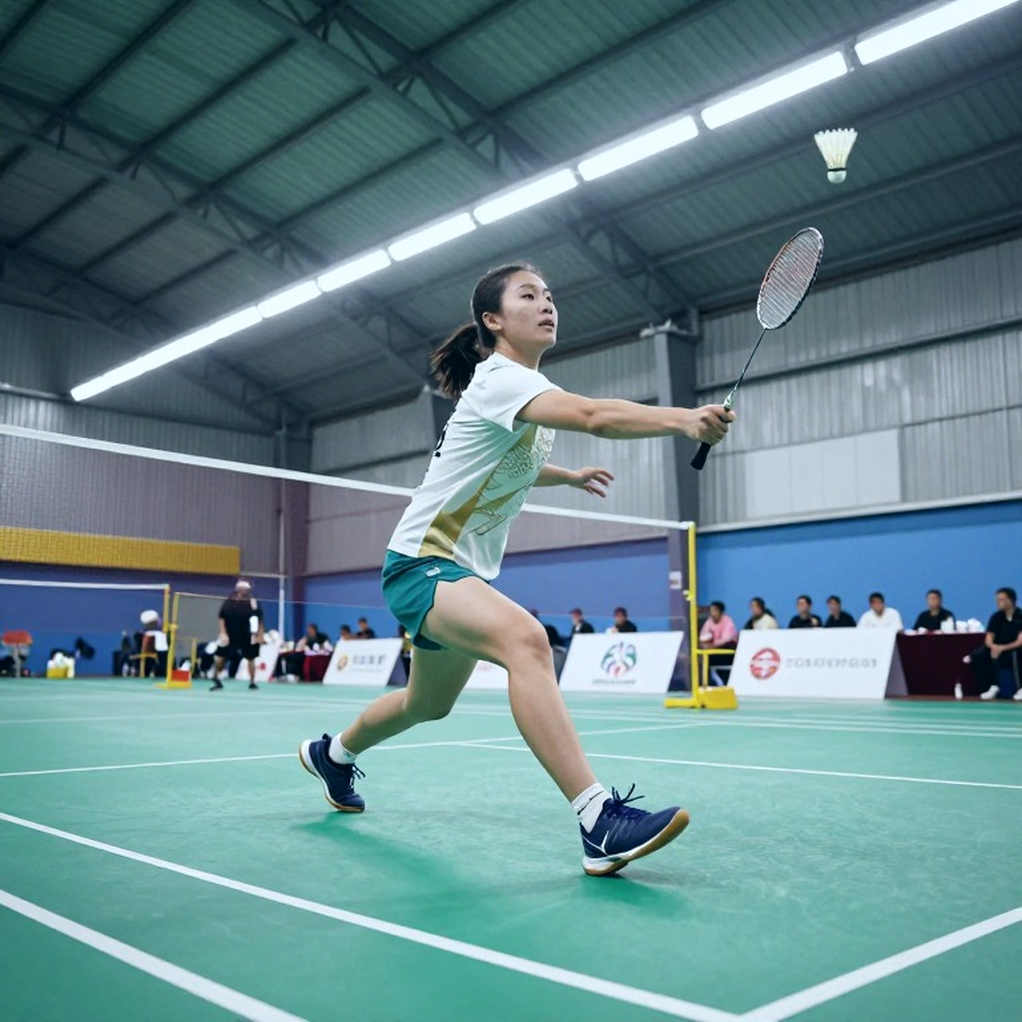
Add it up: 13 games, 187 points won and 153 conceded, a net swing of +34. The scorelines indicate best-of-three games to 15, rally scoring, with a two-point margin required at 14-all. One note on source quality is essential: the original results brief in my hands carries no byline, no direct quotes and no reference to official Badminton Asia or BWF technical documents. Every figure above is therefore single-source and needs cross-checking before it is cited.
The only signal strong enough to trust is the third game
Three of her four played matches went the distance. That is more telling than any description of playing style, because the original brief contains no line at all about strokes, court coverage, tempo or shot selection.
The most durable technical signal from Chengdu is third-game conversion, not any signature stroke. She won all three deciders by 2, 4 and 3 points, and in the final she lost the opening game before taking the next two. This is a repeating pattern, not a single lucky escape.
There is a symmetrical signal, and it is less flattering: in three of four matches, Patri dropped at least one game, including an 11-15 opening loss in the final. The truer portrait is a resilient front-runner with variable starts, not a wire-to-wire winner. Two straight-game wins over Kashio and Lin Heng Men show that once she finds rhythm she closes games cleanly — which argues against her being purely a grinder. The problem is that within the same week, her ceiling and her floor remain far apart.
In a 15-point format, the first five points carry far more weight than they do in the senior 21-point system. A short game turns every opening exchange into a leveraged investment, while compressing the reward for long rally construction — the very thing that defines elite badminton. Put plainly: in a 21-point system you build a game; in a 15-point system you seize it. Any inference that she is senior-ready must therefore be heavily discounted.
I remember this feeling from a different arena. During my years hosting broadcasts at major events, I once sat down after a show and asked myself why the same set of athletes produced two different sets of numbers — the answer always lay in the rules, not in the people. Athletics teaches you about the finish, football teaches you about the journey, and esports teaches you both compressed into a single team fight. Age-group badminton sits at the intersection of all three: a match lasting a few dozen minutes, decided inside two-beat windows.
Borrow esports language: a 15-point game resembles a major objective fight — one objective, one window, and the whole map tilts. Borrow football language: five substitutions turn the final twenty minutes into a war of attrition, and the 15-point format turns the first five points into exactly that war, at a smaller scale. Borrow relay language: what decides is not absolute speed but the timing of the baton exchange — and for Patri, the baton exchange seems to arrive a game late.
On the ranking side, this title creates no high-level points to defend. Continental age-group events sit outside the 52-week decay cycle of the senior system, so points-defence pressure is zero. Her second seeding brought a first-round bye — a draw-position advantage, standard practice in junior continental draws. Seeding at age-group level is assigned largely on regional results and national association nomination, making it a weak proxy for absolute level.
And this is the most striking part of the whole week in Chengdu.
The headline is not the champion but the fact that India placed two players in a continental final — and retained the girls' U17 title for a second straight year, after Diksha Sudhakar in 2026. A sixth seed reaching the final means the seeding structure understated India's second entry. That is a depth signal. Continental draws apply same-association separation, so the all-Indian final is structural: the two players won separate halves.
Head-to-head data is statistically void. Every meeting is a first meeting, no opponent repeats, meaning no bogey opponent and no style-counter relationship can exist yet. For a U17 player in the 2026 cycle, the credible development window falls closer to 2032 than to a 2028 Olympic berth — but the original brief provides no date of birth, so this is directional only.
The contrarian angle: the mental-strength label and the four-match trap
The phrase immense mental strength that many briefs attach to juniors who win three-game matches is an editorial inference, not a measured psychological trait. Journalists attach that label to almost every three-game win. With scorelines as the only data, no one can separate fortitude from a slow warm-up or a deliberate feel-out first game.
The bigger trap is sample size. Four matches, one event, one age group. Every conclusion about Patri's ceiling from this week rests on four observations. She beat three Chinese players on Chinese soil in front of a home crowd — a mild but genuine quality marker, since away pressure at age-group level often exceeds the senior equivalent. It says nothing, however, about how she handles non-Asian styles.
One concern is institutional rather than personal. When continental junior events use 15-point games while the senior tour uses 21, associations that optimise juniors for short-format play risk under-preparing them for senior conditions. That trace appears on no scoreboard, but it leaves consequences four or five years later.
The best predictive indicator for Patri's future lies outside the Chengdu hall. It is her entry list at senior International Series and International Challenge level over the next two seasons. Junior continental champions who never convert usually stall at precisely that point — not because they lose, but because they are never entered.
What I carried out of Chengdu
People tell me I break conventions, but I am only looking for a common language across different arenas. At 17 I thought I knew everything about sport. At 25 I know I am only good at listening. A U17 title with three deciders won in full deserves its place in the file — and deserves to be read at its true size. What I carried out of Chengdu was a nagging thought: will Tanvi Patri's coaching team have the patience to move her into senior competition at the right moment, before a 16-year-old talent is permanently framed by a 15-point format?